The 11+ in Gloucestershire is changing, and sooner than many families expect. The seven Gloucestershire grammar schools have moved their entrance test from September of Year 6 to the end of the summer term in Year 5, and they have a new test provider, FSCE (Future Stories Community Enterprise), replacing GL Assessment.
The first test under the new arrangements is on Saturday 3 July 2027, for children starting Year 7 in September 2028. That means children in Year 5 right now are the first to sit it, about two months earlier in their school life than any year group before them.
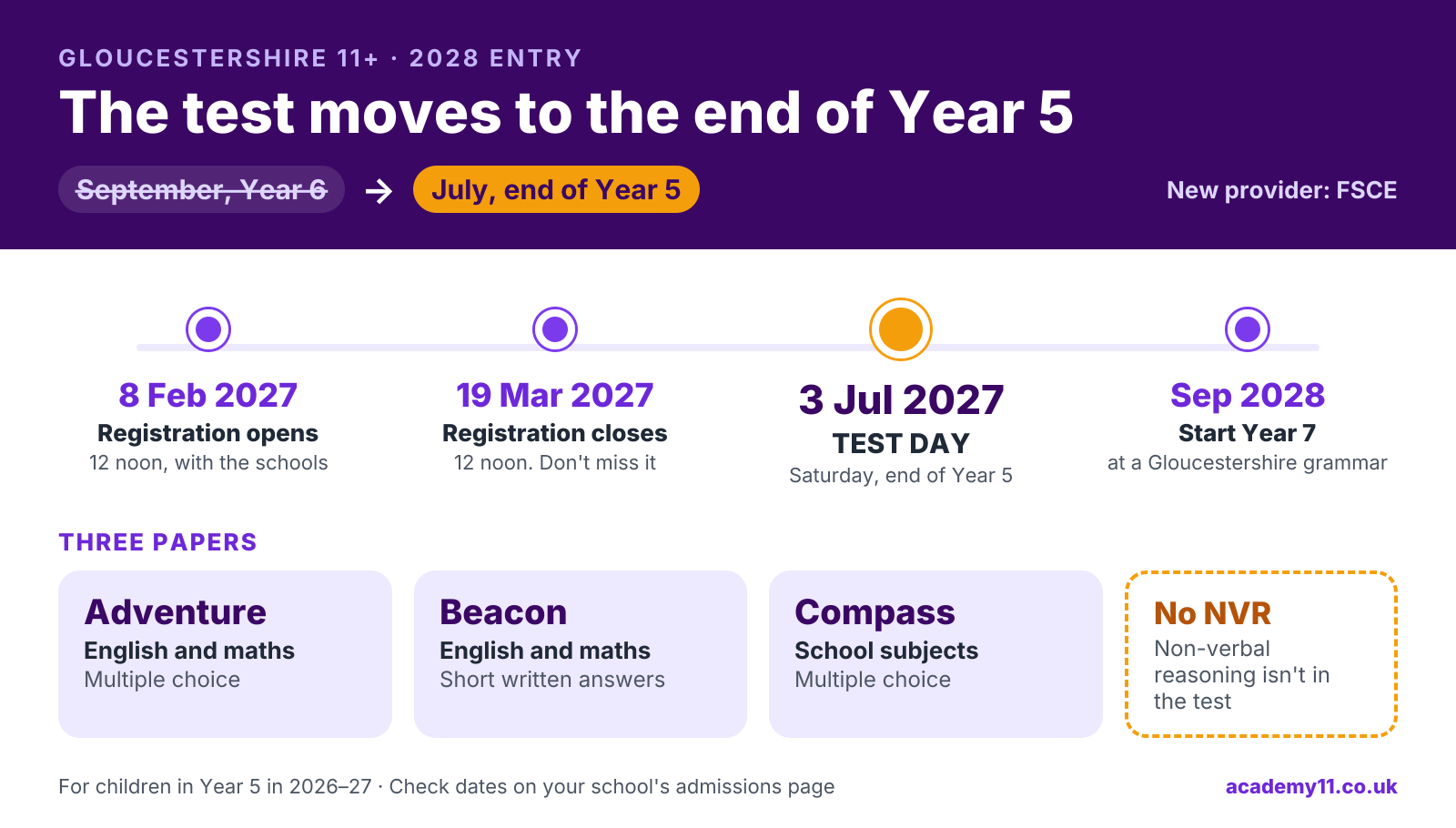
Gloucestershire 11+ for 2028 entry: the key dates and the three papers.
Which schools are involved?
The change covers all seven Gloucestershire grammar schools, which use one shared test:
- Pate's Grammar School, Cheltenham
- Denmark Road High School, Gloucester
- Ribston Hall High School, Gloucester
- Sir Thomas Rich's School, Gloucester
- The Crypt School, Gloucester
- Marling School, Stroud
- Stroud High School, Stroud
Your child sits the test once, at one of the seven schools, and each school then applies its own admissions criteria and qualifying score.
Who is affected?
Children in Year 5 in the 2026–27 school year who want a place at a Gloucestershire grammar school in September 2028. The schools' own admissions pages are clear that children currently in Year 5 who wish to apply must take this test in July 2027.
If your child is in Year 4 now, they will follow the same pattern a year later, sitting the test at the end of Year 5 in summer 2028. Check the schools' pages nearer the time, as dates are confirmed each year.
Why are the schools making the change?
When the change was announced in April 2026, the schools said moving the test would reduce pressure on pupils beginning Year 6 and give families earlier results. They chose FSCE through a competitive tender, with fair access for pupils from all backgrounds as a key aim. FSCE's tests are based on what children learn at school in Key Stage 2 rather than on specialist 11+ question types.
What does the new test look like?
The test is three FSCE papers. The schools' familiarisation guides describe them like this:
Adventure paper: English and maths, with multiple-choice answers.
Beacon paper: English and maths, where children write short answers themselves rather than choosing from options.
Compass paper: multiple-choice questions on subjects children learn at school: art and design, computing, design and technology, English, geography, history, languages, maths, music, PE and science.
No non-verbal reasoning
FSCE says non-verbal reasoning isn't part of its tests because it isn't taught in the Key Stage 2 National Curriculum, and verbal reasoning isn't listed as a paper either. If your child has been practising NVR puzzles for Gloucestershire, that time is better spent on reading, vocabulary, maths and broad general knowledge.
A few practical details from the familiarisation guides, worth knowing early:
- Short-answer questions use one digit or one capital letter per box, so neat, careful writing matters.
- Instructions and timings are read out on an audio recording.
- No calculators, rulers, protractors, scrap paper or watches. Clocks are provided.
- Wrong answers don't lose marks, so children should never leave a question blank.
- Scores are age-standardised, so younger children in the year group aren't at a disadvantage.
- The test only covers content up to the end of Year 5.
How is FSCE different from GL?
GL Assessment has set the Gloucestershire test until now. The biggest differences for families are the earlier date, the written short answers in the Beacon paper, and the Compass paper, which rewards a broad general education across school subjects rather than practice of specific 11+ question types.
FSCE also doesn't publish past papers or sell practice papers. It says its content and question types change from year to year. The only official preparation is the free familiarisation material on each school's admissions page.
Be careful with "FSCE practice papers"
Because FSCE publishes no past papers, any paper sold as an "official FSCE paper" isn't one. Use the schools' free familiarisation guides to learn the format, and spend the rest of your time on the core skills the test is built on.
What it means for your Year 5 child
The main effect is time. Families used to have the whole summer before Year 6 to prepare. Now the test arrives at the end of Year 5, so there are roughly seven months between now and test day, with registration closing in March.
The good news is that the content is the school curriculum up to the end of Year 5, so steady work on reading, writing and maths pays off directly, both in the test and at school.
A plan from now to July 2027
December and January: read the familiarisation guides
Download the children's and parents' familiarisation guides from any of the seven schools' admissions pages. Go through the sample questions together so the three papers and the answer sheet aren't a surprise.
February to March: register
Registration opens at 12 noon on Monday 8 February 2027 and closes at 12 noon on Friday 19 March 2027. It's done directly with the grammar schools, not the council. Put both dates in your calendar now.
Every week: reading and vocabulary
Daily reading, talking about new words, and short comprehension questions build the English skills the Adventure and Beacon papers test.
Every week: Year 5 maths, without a calculator
Times tables, fractions, decimals and percentages, measures and problem solving, all done mentally or with written methods, since calculators aren't allowed.
Practise short written answers
Get used to writing one clear digit or capital letter per box, and checking spelling, because the Beacon paper isn't multiple choice.
Broaden general knowledge for Compass
Talk about history, geography and science topics from school, visit museums, watch documentaries together, and look at art and music. The Compass paper draws on all of these.
May to June: timed practice
Practise working to time with the clock on the wall, no watch, and never leaving a multiple-choice question blank, because wrong answers don't lose marks.
Always check the official pages
Test dates, registration windows and results dates are set by the schools each year. This guide summarises the schools' published information as of November 2026. Check the admissions page of the school you're applying to for the latest details.
How Academy11+ can help
FSCE doesn't publish past papers, so we haven't made "FSCE papers". What we do have builds exactly the skills this test rewards:
- Our week-by-week 11+ course: English and maths lessons that follow the curriculum, with practice and quizzes for every topic.
- Free 11+ lessons: short video lessons on maths and English topics, with notes for parents.
- The Daily 10: ten free questions a day to keep skills ticking over.
- Free formula sheets: one-page maths summaries to print and pin up.
- Free mock day on 12–13 December 2026: timed English and maths practice under exam conditions, good for building the habit of working to time.
Use your free Academy11+ account alongside the schools' familiarisation guides, and you'll have the format and the skills covered.
Frequently asked questions
When is the Gloucestershire 11+ test for 2028 entry?
Saturday 3 July 2027, at the end of the summer term of Year 5. It's for children who will start Year 7 in September 2028.
When do I register?
From 12 noon on Monday 8 February 2027 to 12 noon on Friday 19 March 2027. You register directly with the Gloucestershire grammar schools.
Is there non-verbal or verbal reasoning in the new test?
No non-verbal reasoning: FSCE says it isn't part of the Key Stage 2 curriculum. The three papers are English and maths (multiple choice), English and maths (short written answers), and a multiple-choice paper on school subjects.
Are there FSCE past papers?
No. FSCE doesn't publish past papers or authorised practice papers, and says its questions change each year. The official preparation is the free familiarisation material on the schools' websites.
When will we get results?
The schools say the earlier test date means families get results sooner. Check the Key Dates document on your chosen school's admissions page for the exact results date and the secondary application deadline.