The Kent Test is moving from GL Assessment to Quest Assessments. Kent County Council has appointed Quest to write and run the 11+ for children applying for secondary school places in September 2028: that's children who are in Year 5 now, the first cohort to sit the Quest version, in September 2027. Children in Year 4 and younger will sit it too. If your child is in that year group, this guide explains what's changing, what isn't, what Quest-style questions look like and how to prepare, using only official information from Kent County Council and Quest itself.
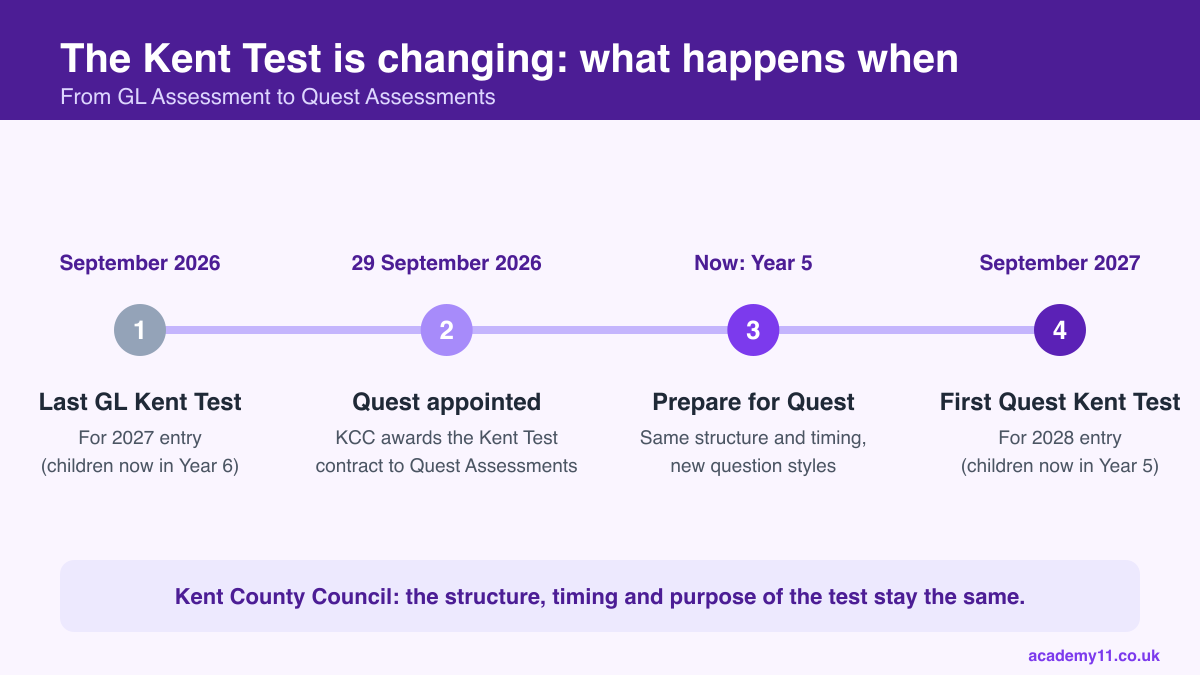
The Kent Test is changing provider: what happens when.
The Kent Test and Quest in short
From the September 2027 test (for 2028 entry), the Kent Test is written by Quest Assessments instead of GL Assessment. Kent County Council says the structure, timing and purpose of the test stay the same. Children who sat the test in September 2026 (now in Year 6) took the last GL version. Kent-specific Quest practice material hasn't been published yet: the council says it will share new familiarisation materials when it has them.
Who is affected?
Children in Year 5 in the 2026–27 school year (born between 1 September 2016 and 31 August 2017) are the first to sit a Kent Test written by Quest, in September 2027, for a place in Year 7 in September 2028. Children in Year 4 and younger will also sit the Quest version. Children in Year 6 now have already sat the last GL Kent Test.
Who are Quest Assessments?
Quest Assessments is the assessment arm of Atom Learning. It already writes 11+ tests for Bexley (since the September 2026 test), Wirral, Plymouth, Colyton and several independent and grammar schools, and from 2028 entry it also takes over in Dorset and Slough. In September 2026 Kent County Council awarded it the contract for the Kent Test (11+) services, covering the test material, distribution, marking and results.
Quest also runs an online adaptive test used by many independent schools. The Kent Test isn't that: like Bexley's Quest test, grammar school tests are paper-based multiple choice, with answers marked on a separate answer sheet.
What stays the same in the Kent Test
Kent County Council has said the structure, timing and purpose of the test will stay the same, and that the new provider works to the same specification as before. So, based on the Kent Test as it is now, you can expect:
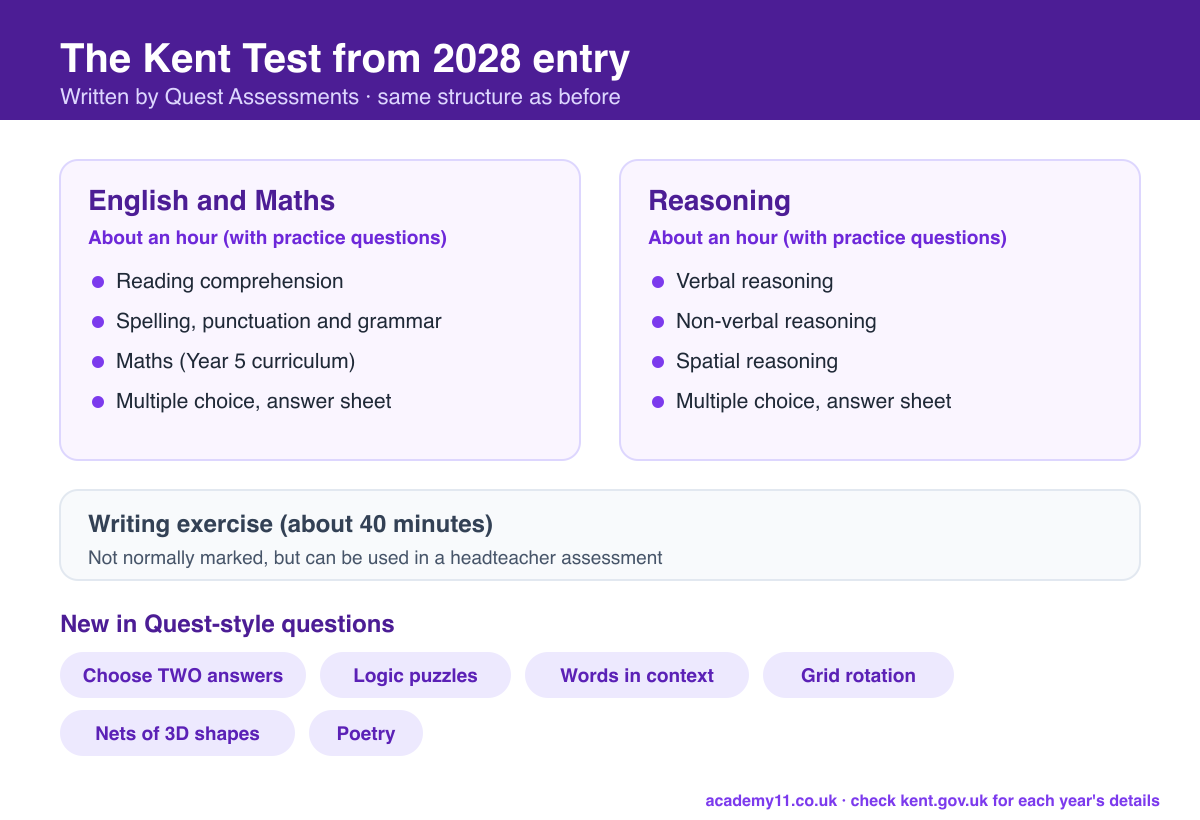
The Kent Test's shape stays the same: an English and Maths paper, a Reasoning paper and a writing exercise.
An English and Maths paper (about an hour, including practice questions): reading comprehension, spelling, punctuation and grammar, and maths based on the curriculum up to the end of Year 5.
A Reasoning paper (about an hour, including practice questions): verbal, non-verbal and spatial reasoning.
A writing exercise (about 40 minutes), which isn't normally marked but can be used if a headteacher assessment is needed.
All the marked papers are multiple choice, with answers recorded on an answer sheet. As now, check Kent County Council's Kent Test pages each year for the exact papers, dates and timings.
What Quest-style questions look like
Quest publishes free familiarisation booklets for its grammar school tests: one each for English, Maths, Verbal Reasoning and Non-Verbal Reasoning, each with 20 questions to do in 20 minutes. Quest says each school's test is slightly different, so these show the kinds of questions, not the exact Kent mix. Here's what stands out compared with GL papers.
Verbal reasoning
Many questions ask children to choose two answers: two words, one from each group, that are closest in meaning or opposite; or analogy pairs such as "wring is to (finger, twist, cloth) as knead is to (kicked, dough, require)". There are two odd ones out from five words, the meaning of a word in a short paragraph, the best word to complete a sentence, and three missing letters in a word.
About a quarter of the booklet is logic: which conclusion follows from a paragraph, working out a date from clues, map and timetable puzzles, and statements that must be true or cannot be true. Notably, the booklet has no letter codes, letter or number series, hidden words or move-a-letter questions, which are common in GL verbal reasoning.
Non-verbal and spatial reasoning
Sequences and grids, as in GL papers, plus a lot of spatial work: rotating a shaded grid by 90°, reflecting a shape in a diagonal mirror line, completing a symmetrical design, folding and cutting paper, which 3D shape a net makes (prisms and pyramids, not just cubes) and which cube a net makes, including dice faces.
English
A story passage with questions about the writer's choices ("what is the effect of…", "why does the author include…"), then short spelling, punctuation and grammar questions asked one sentence at a time: which part of a sentence has a mistake (or none), where a question mark should go, which sentence is punctuated correctly, which word can replace the underlined words, and words with the same or opposite meaning. Tutors who've seen Quest papers also report poetry passages.
Maths
Mostly arithmetic and Year 5 topics, with a few puzzle-style questions: a fraction pyramid, missing digits in a long multiplication, and "choose all of the common factors", where more than one answer is right.
The big new habit: "choose two"
On a Quest answer sheet, some questions need two (or more) boxes marked. Children used to GL papers are trained to pick exactly one answer, so practise reading the question carefully for "choose the two…" or "choose all…", and marking every right answer. Getting one of two right usually scores nothing.
What we can learn from Bexley
Bexley's Selection Test switched to Quest in September 2026, so it's the best guide to how a grammar school area's Quest test works. Bexley's test is two papers of about 50 minutes each: verbal ability and English comprehension, then numerical reasoning and non-verbal reasoning, all multiple choice on an answer sheet, with options A to E. The structure stayed close to Bexley's previous test, just as Kent's is expected to.
Other areas moving to Quest
Kent isn't alone. For 2028 entry, Dorset (Bournemouth School, Bournemouth School for Girls, Parkstone and Poole Grammar) moves to three 40-minute Quest papers in Maths, English and Verbal Reasoning (no non-verbal reasoning), and the Slough consortium moves to Quest with two papers covering English, maths, verbal and non-verbal reasoning. The Latymer School is also moving to Quest for 2028 entry.
How to prepare for the Quest Kent Test
A plan for Year 5 families
Keep building the core skills
The subjects haven't changed: reading, vocabulary, spelling and grammar, Year 5 maths, and verbal, non-verbal and spatial reasoning. Strong core skills transfer whatever the provider.
Read widely, including poems
Comprehension questions focus on the writer's choices and effects. Reading stories, non-fiction and poetry together, and talking about why a writer chose a word, helps most.
Grow vocabulary
Synonym and antonym pairs, words in context and sentence completion all depend on knowing lots of words. A few new words a day, used in sentences, adds up.
Practise logic and spatial puzzles
Logic deductions, nets of 3D shapes, rotations and reflections are a bigger part of Quest's reasoning than many families are used to.
Learn the "choose two" habit
Practise questions where more than one answer is right, and check every question for "choose the two" or "choose all".
Use Quest's free booklets
Download Quest's familiarisation booklets and its practice answer sheet, and try them once, timed: 20 questions in 20 minutes.
Do timed mocks
Sitting a full Kent-style mock under timed conditions shows where time runs out and builds confidence for the real day.
Key dates to watch (Year 5 in 2026–27)
Always check the official pages
Details such as test dates, registration windows and familiarisation materials are set by Kent County Council each year. Treat this guide as a summary and check kent.gov.uk/kenttest for the latest information.
How Academy11+ can help
We've built Quest-style practice from Quest's own published question types, including the "choose two" questions:
Free Kent Test-style (Quest) mock day on 12 and 13 December 2026: an English and Maths paper and a Reasoning paper, sat at home in the exam window, with results on 20 December. See the Kent mock exams
Quest-style practice papers: Kent-style papers from 2028 entry, plus short Quest Maths, English, Verbal Reasoning and Non-Verbal Reasoning papers, all marked straight away with an explanation for every question. Browse the paper packs
Frequently asked questions
Is the Kent Test still multiple choice with Quest?
Yes. Kent County Council has said the structure of the test stays the same, and Quest's grammar school tests are multiple choice on a paper answer sheet, with options usually A to E. The difference is that some Quest questions ask for more than one answer, so children need to read each question carefully.
Does the Kent Test still include verbal and non-verbal reasoning?
Yes. The Reasoning paper is expected to keep verbal, non-verbal and spatial reasoning, because the council has said the structure stays the same. What changes is the style of question: Quest's verbal reasoning leans more on vocabulary pairs and logic, and its non-verbal reasoning includes a lot of spatial work such as nets and rotations.
Are old GL Kent practice papers still useful?
Yes, for core skills: reading, grammar, maths and reasoning are the same subjects. But some GL question types (such as letter codes and number series) may not appear, and Quest has types GL doesn't use, such as choose-two questions and logic deductions. A mix of GL-style practice for skills and Quest-style practice for the format is a sensible balance.
When will Kent publish Quest familiarisation materials?
Kent County Council has said new familiarisation materials will be available when it has them, but hasn't given a date. Until then, Quest's general grammar school booklets on its website show the kinds of questions to expect. Check kent.gov.uk for updates.