On 21–22 November, Year 5 children sat our online 11+ mock day at home: GL, CEM-style, ISEB Common Pre-Test and Sutton SET-style papers, timed like the real thing. Results are out, and every family has a full report for their own child. Here is the big picture: how the year group did, where marks were lost, and what to practise before the next mock.
The headline: a strong start
The average score across every paper was 76%, and 43% of papers scored 80% or more. For children still a year away from the real test, that is a good place to be. It also means the gap between a solid score and a standout one is small: a few careful marks can move a child up the rankings.
How each subject went
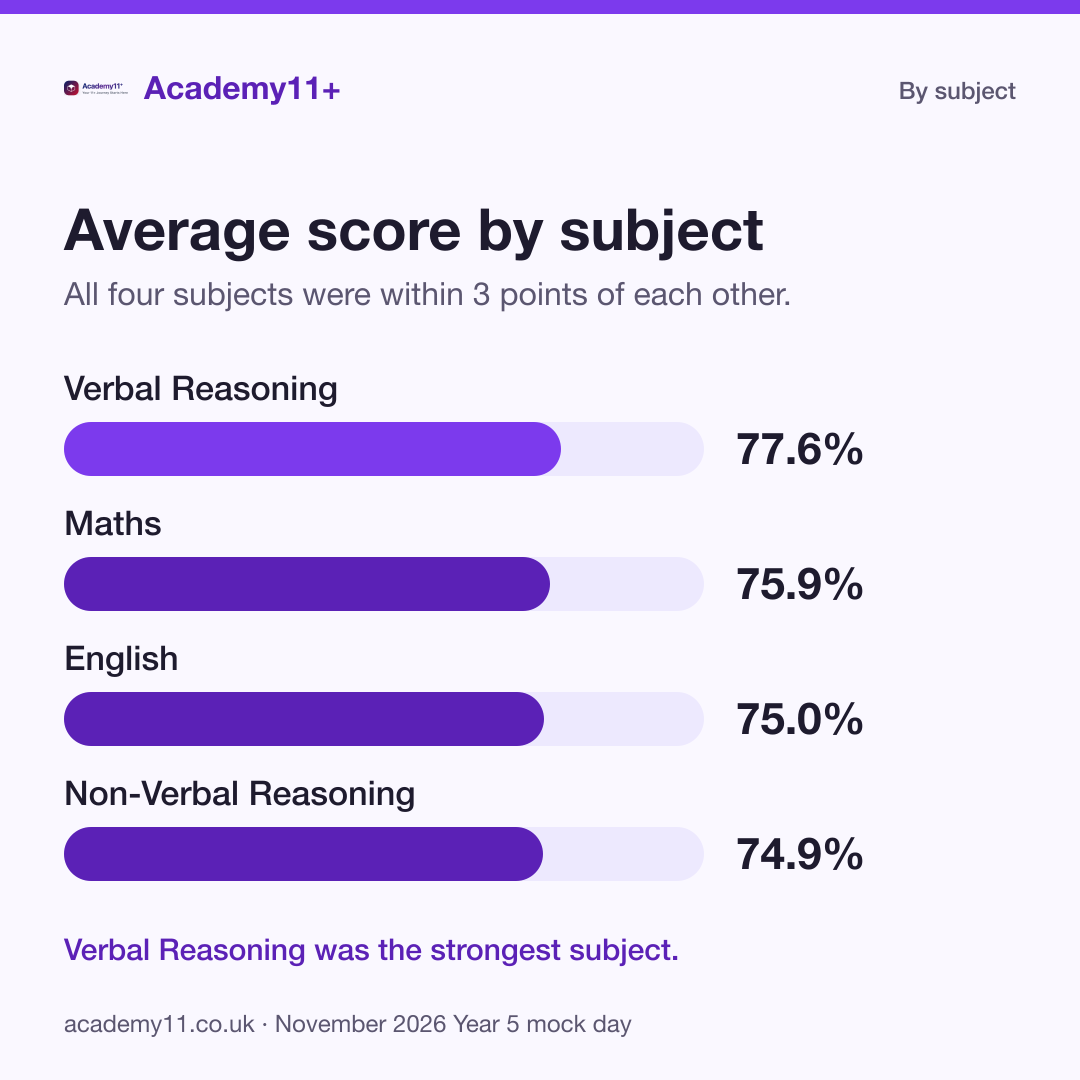
Average score by subject, all exam boards together.
Verbal Reasoning was the strongest subject (77.6%), then Maths (75.9%), English (75.0%) and Non-Verbal Reasoning (74.9%). All four were within three points of each other, so no subject was a disaster area. The differences show up inside each subject, in particular topics.
By exam board, Sutton SET-style papers averaged 77.5%, GL 76.8%, CEM-style 75.1% and ISEB 73.0%. ISEB English was the toughest single paper, which fits: it asks for careful reading under time pressure.
Where did scores land?
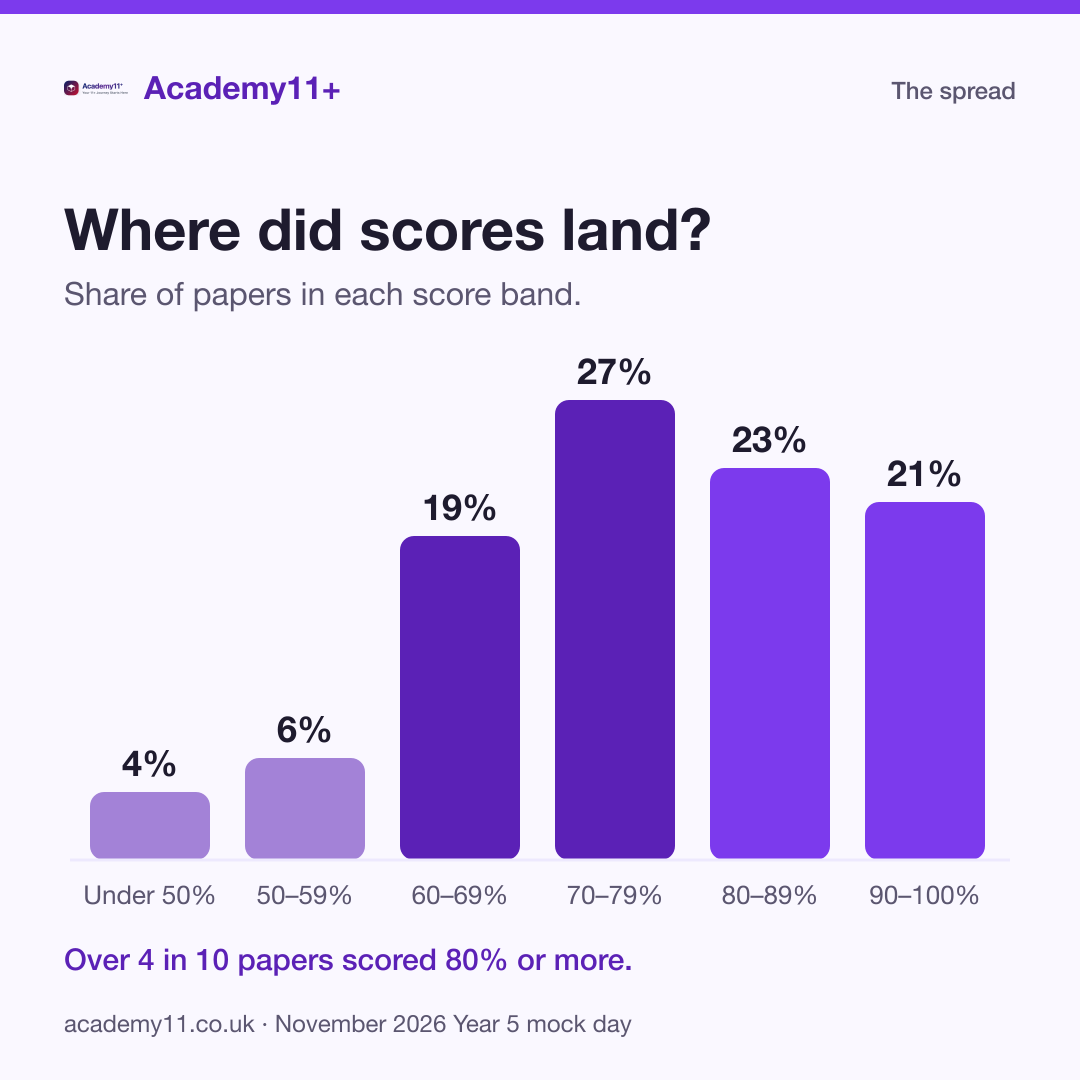
Share of papers in each score band.
The biggest group scored 70–79%, with almost as many in the 80s and the 90s. Only one paper in ten scored under 60%, and many of the very low scores were papers left before the end, not true results. If your child scored in the 70s, the next step is usually accuracy and timing rather than new topics.
The five toughest topics
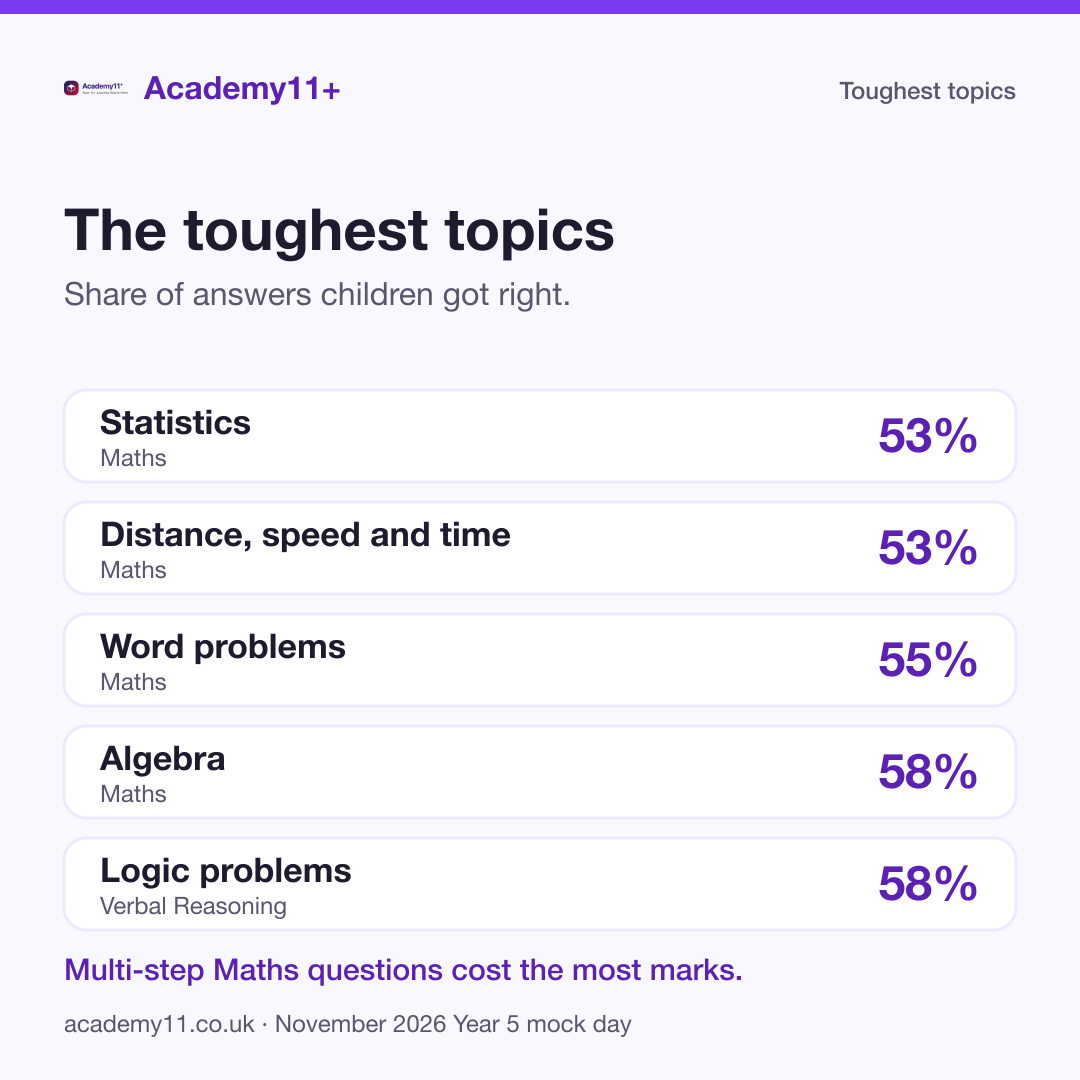
Share of answers children got right in each topic.
Four of the five toughest topics were Maths, and they have one thing in common: they take more than one step. Children often knew the method but slipped on the second or third step, or ran out of time.
- Statistics (53% right): reading charts and tables, then working something out from them. Practise: read the question twice, then mark the values you need on the chart. Statistics study guide
- Distance, speed and time (53%): the formula is easy; changing units (minutes to hours) is where marks go. Distance, speed and time guide
- Word problems (55%): turning words into a calculation. Practise underlining the numbers and the question word. Word problems guide
- Algebra (58%): missing numbers and simple equations. Children rush the last step. Algebra guide
- Logic problems in Verbal Reasoning (58%): several clues to hold in mind at once. Drawing a quick table helps. Logic problems guide
Try the hardest question from each topic
These are real questions from the mock: in each topic, the one children found hardest. Pick an answer to see if you're right, then read how to work it out. A good one to try together with your child.
Quiz Question
Statistics (21% got this right). The mean age of 8 children in a group is 10. When their teacher joins the group, the mean age becomes 12. How old is the teacher?
Quiz Question
Distance, speed and time (50% got this right). A train travels 75 miles at 30 mph. How long does the journey take?
Quiz Question
Word problems (29% got this right). Samuel wants to buy a board game that costs £41.50. He already has £8 and saves £2.50 each week. What is the smallest number of weeks before he has enough money?
Quiz Question
Algebra (21% got this right). Multiply out and simplify: 4(m + 5) + 5(m + 1)
Quiz Question
Logic problems (21% got this right). Ben, Grace, Mia, Nina and Theo sit in a row of five seats, all facing the same way. Nina sits somewhere to the left of Ben. Ben sits directly to the left of Grace. Nina does not sit next to Mia. Nina does not sit next to Ben. Who sits second from the left?
What children did best
Verbal Reasoning word puzzles were the most secure: odd two out, missing letters, hidden words and letter sums were all answered correctly around 90% of the time or more. In Non-Verbal Reasoning, odd one out (95%), series and matrices were strong. English comprehension was solid too, at 81%.
What to do before the next mock
- Open your child's mock report. It shows their score on each paper, how they compare with everyone who took part, and the topics to work on.
- Pick two weak topics, not ten. Short, regular practice on two topics beats a long session on everything.
- Practise multi-step Maths questions slowly first, then timed. Accuracy first, speed second.
- Sit the December mock to see what has improved. Comparing two mock results is the clearest sign of progress.
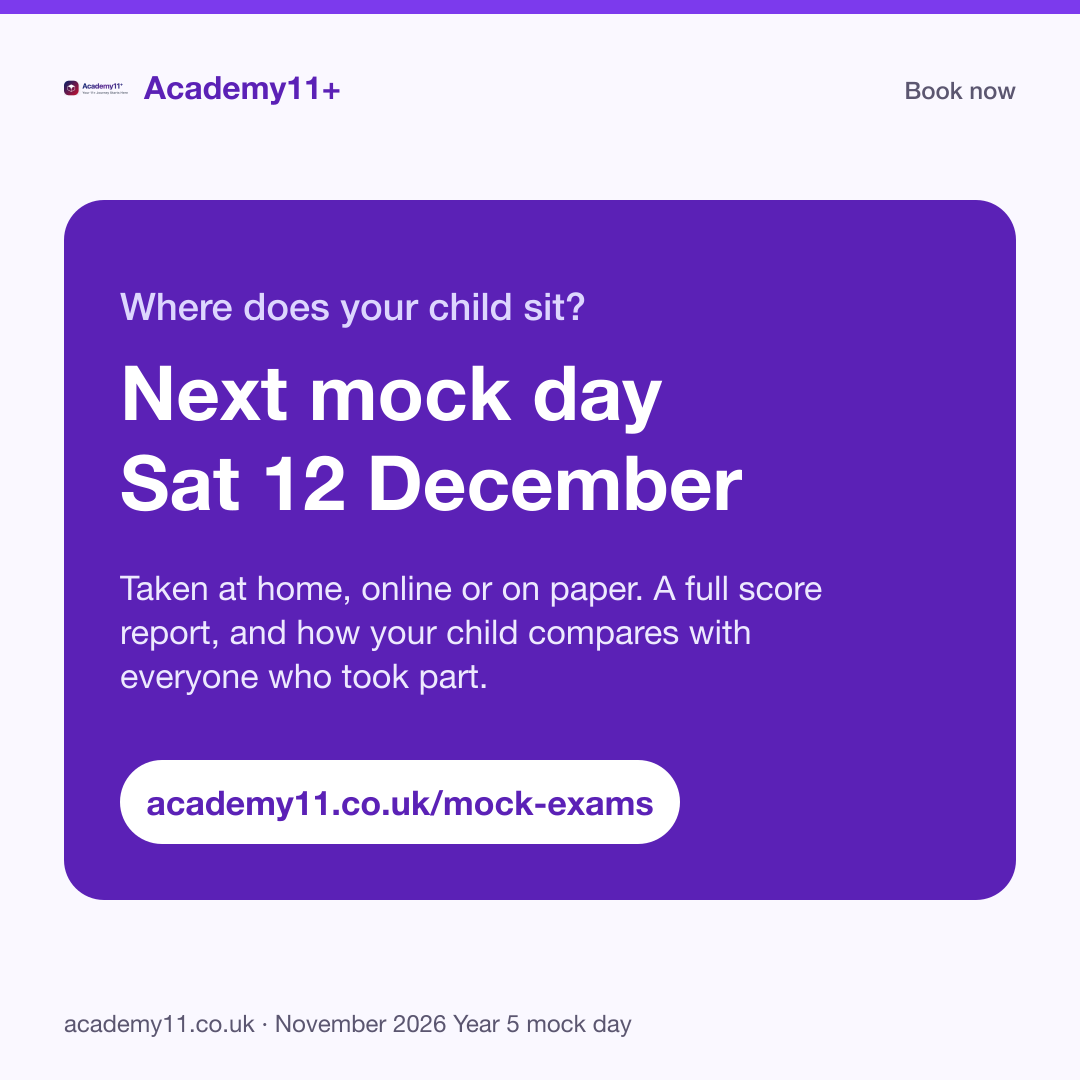
Book the December mock day.
The next mock day is Saturday 12 December. Papers are sat at home, online or on paper, with a full score report and a comparison with everyone who took part. See the mock exams.